Don't get me wrong, I love our country. The freedoms we are afforded are unlike any in the world. But being married to a research scientist has made me naturally question any type of survey or broad proclamation. So this got me thinking obsessing with the question, "What are we actually the best in?". The results are what I figured. As a country, we are statistically.....okay. Does this mean we live in a terrible country? Nope. It means we have plenty of room for improvement and that we need to continue to forge forward with the drive of integrity and progression that we are known for.
Showing posts with label Education. Show all posts
Friday, July 24, 2020
A mathematical look at where the United States ranks in the world.
If one were to look from afar into the United States right now, they couldn't help but to be afraid of what they see. COVID-19 cases are through the roof, and the U.S. has raced to the front of the line since March. Social media is a conflagration of people claiming masks don't help at all, the virus isn't real, and even wearing a mask for ten minutes at a grocery store is infringing upon their rights as an American. Yet as a collective country, we seem to continue to chant that "USA IS NUMBER ONE!".
Labels:
AFL-CIO,
change,
DNC,
Education,
FutureCaucus,
government,
labor,
law,
leadership,
life,
millennials,
MLAP,
politics,
Tedtalks
Tuesday, August 6, 2019
Places where collective bargaining....is ILLEGAL???
Collective bargaining is defined as the negotiation of wages and other working conditions by an organized group of employees. While individuals will try and argue the case for a non-union private sector, the case for public sector unionization is almost undebatable.
Private-sector unionization is mainly covered under the National Labor Relations Act, or NLRA. However, public-sector unionization is generally under the scope of specific states, and even local jurisdictions at times. This creates an almost mandatory symbiotic relationship for public sector unions to get involved politically, as it can become a fight to just survive, let alone thrive. The map below shows a general layout for the United States, which displays the laws as they pertain to each state and their public-sector unions. It's important to note that teachers don't have the same CBA laws that police and firefighters have.
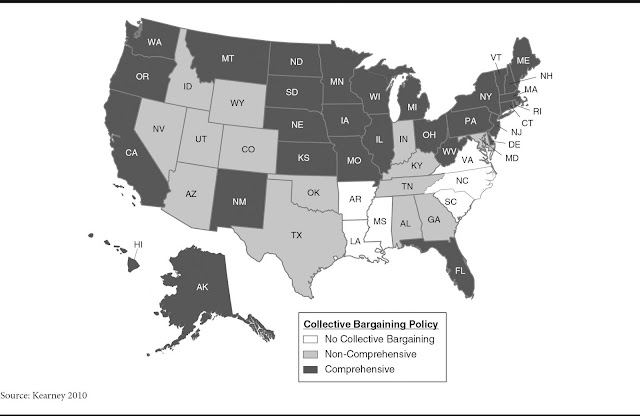
So what does collective bargaining, or lack thereof, do for these states? The answer to that depends on where you live and what line of work you are in. For example, a firefighter may be covered by a better insurance plan that they have collectively bargained for throughout their contract. Since firefighters are 156% more likely than the average citizen to get some form of cancer in their career, their medical needs are different.
Private-sector unionization is mainly covered under the National Labor Relations Act, or NLRA. However, public-sector unionization is generally under the scope of specific states, and even local jurisdictions at times. This creates an almost mandatory symbiotic relationship for public sector unions to get involved politically, as it can become a fight to just survive, let alone thrive. The map below shows a general layout for the United States, which displays the laws as they pertain to each state and their public-sector unions. It's important to note that teachers don't have the same CBA laws that police and firefighters have.
So what does collective bargaining, or lack thereof, do for these states? The answer to that depends on where you live and what line of work you are in. For example, a firefighter may be covered by a better insurance plan that they have collectively bargained for throughout their contract. Since firefighters are 156% more likely than the average citizen to get some form of cancer in their career, their medical needs are different.
Labels:
AFL-CIO,
DNC,
Education,
GOP,
government,
labor,
law,
leadership,
millennials,
MLAP,
USA
Thursday, June 29, 2017
Why is education a key factor in the political picture?
One of the main reasons I decided to start this blog is due to the educational component of what it can offer. I don't expect everyone to agree with everything that I present, but if someone reads my article, processes the lesson, then decides, "Meh, that's just not for me", I completely understand that thought. Politics are interesting to me because they are, at times, slow moving like a turtle.
More so, politics in the United States are progressing at a snails pace. Without entering into a generational fisticuffs and blaming a certain age group, lets just say that the long march of progress can be undone with one uneducated vote. As kids, we've all worked extremely hard on that time consuming Lego castle, only to have a sibling come in and kick it over and destroy it. It's much easier to dismantle something than to build. Thus, we arrive at politics today.
Labels:
AFL-CIO,
change,
DNC,
Education,
GOP,
IAFF,
labor,
leadership,
MLAP,
politics,
Right to work,
Tedtalks,
USA,
workers
Subscribe to:
Posts (Atom)


