Showing posts with label AFL-CIO. Show all posts

Friday, July 24, 2020

A mathematical look at where the United States ranks in the world.

If one were to look from afar into the United States right now, they couldn't help but to be afraid of what they see. COVID-19 cases are through the roof, and the U.S. has raced to the front of the line since March. Social media is a conflagration of people claiming masks don't help at all, the virus isn't real, and even wearing a mask for ten minutes at a grocery store is infringing upon their rights as an American. Yet as a collective country, we seem to continue to chant that "USA IS NUMBER ONE!". 


Don't get me wrong, I love our country. The freedoms we are afforded are unlike any in the world. But being married to a research scientist has made me naturally question any type of survey or broad proclamation. So this got me thinking obsessing with the question, "What are we actually the best in?". The results are what I figured. As a country, we are statistically.....okay. Does this mean we live in a terrible country? Nope. It means we have plenty of room for improvement and that we need to continue to forge forward with the drive of integrity and progression that we are known for. 

Tuesday, August 6, 2019

Places where collective bargaining....is ILLEGAL???

Collective bargaining is defined as the negotiation of wages and other working conditions by an organized group of employees. While individuals will try and argue the case for a non-union private sector, the case for public sector unionization is almost undebatable.

Private-sector unionization is mainly covered under the National Labor Relations Act, or NLRA. However, public-sector unionization is generally under the scope of specific states, and even local jurisdictions at times. This creates an almost mandatory symbiotic relationship for public sector unions to get involved politically, as it can become a fight to just survive, let alone thrive. The map below shows a general layout for the United States, which displays the laws as they pertain to each state and their public-sector unions. It's important to note that teachers don't have the same CBA laws that police and firefighters have.
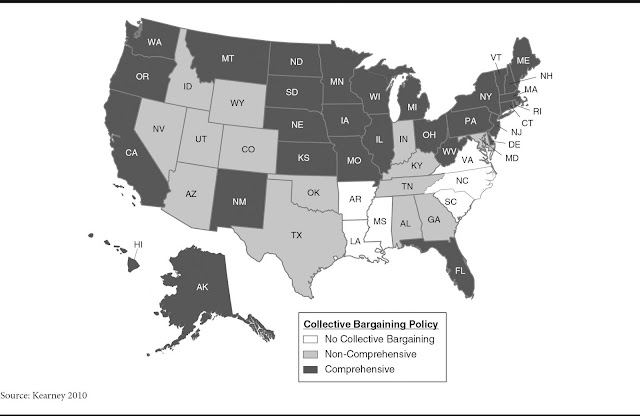

So what does collective bargaining, or lack thereof, do for these states? The answer to that depends on where you live and what line of work you are in. For example, a firefighter may be covered by a better insurance plan that they have collectively bargained for throughout their contract. Since firefighters are 156% more likely than the average citizen to get some form of cancer in their career, their medical needs are different.
Thursday, June 29, 2017

Why is education a key factor in the political picture?

One of the main reasons I decided to start this blog is due to the educational component of what it can offer. I don't expect everyone to agree with everything that I present, but if someone reads my article, processes the lesson, then decides, "Meh, that's just not for me", I completely understand that thought. Politics are interesting to me because they are, at times, slow moving like a turtle.
More so, politics in the United States are progressing at a snails pace. Without entering into a generational fisticuffs and blaming a certain age group, lets just say that the long march of progress can be undone with one uneducated vote. As kids, we've all worked extremely hard on that time consuming Lego castle, only to have a sibling come in and kick it over and destroy it. It's much easier to dismantle something than to build. Thus, we arrive at politics today.

Tuesday, May 2, 2017

8 myths about organized labor

A lot of what I do lately has been educating. I always said that if I wasn't a firefighter I would've been a teacher, but they now seem to melding together. 
One of the biggest lessons I've discovered this year is that people make decisions based on what THEY think, not necessarily facts. Ignorance can be a mindset, but more often than not I believe it's due to a lack of education. I still have people that correlate organized labor to Jimmy Hoffa, corrupt officials, and blackmail. Times have changed dramatically, and while the big corporations may like to bring this up as a reminder,

Saturday, April 15, 2017

35 things your employer can't do if you're union.

Hi everyone,
I recently have been diving headfirst into what an employer can and cannot do, both as far as worker discrimination and labor practices. I thought I would send out an email with a little mini-educational session about the National Labor Relations Act
and a list of actions that an employer CANNOT take in regards to union workers. 
So first, a little background....
What's the National Labor Relations Act?

Wednesday, April 12, 2017

How great leaders inspire action

Below is a fantastic video by Simon Sinek. He talks about how great leaders inspire action, not sit back on their throne and make demands. I figured this would be a good share for today.


I hope you enjoyed it and found it thought provoking. Post coming in a few days about labor leadership with a special interview!

Cheers,

Brandon

Saturday, April 1, 2017

Can Millennials bring back bipartisanship?

How many of you actually are willing to turn on a 24 hour news channel right now, and keep it on? I'm willing to bet some individuals can't keep the program on for longer than 20 minutes, mainly due to the bashing that is being spewed out of the screen at an almost alarming rate. It's similar to the girl who climbed out of the T.V. set in the horror film The Ring when it comes to the information flowing out of these shows.
I believe that one of the major problems facing America today when it comes to any type of semi-political talk is the extreme polarization that has taken place with the two major parties. It has gone from, "I probably just don't understand their issues, but at least I can respect they care about something I don't agree with" to the extreme opposite of, "Are you with me? Because if you aren't, you are my enemy and there is no room for common ground anymore." As

Wednesday, March 29, 2017

How to get involved in a campaign!

Hello! My apologies for the long delay, but I'm back! To quickly summarize, I was afforded a very rare opportunity to travel to Washington DC and learn how to run for office and run a campaign by a select group of political consultants. 

The individuals each specialized in a certain part of running a campaign and while it was absolutely astounding to hear some of their stories, it was even more amazing to kick ideas around to them and get some guidance from them. When I arrived, I naturally looked around the room and noticed myself and one other individual that was roughly my age. Everything else was in their forties and dare I say......quite a bit more seasoned. 

Monday, March 13, 2017

Organized labor PAC funding

Let’s talk today a little bit about Political Action Committee funding, or better known as a PAC. Without a doubt, you’ve seen this line thrown around in news articles or heard someone say it when they are debating with other candidates. The old saying is “There are two things in politics: Influence and money.” While this is mostly true, there reasons to participate financially.
The union version of this involves you and your political action chair sitting down and talking about why it’s important to get involved financially, and then asking for a monthly political action fund donation at either state level, international level, or both. If you agree, you then sign a sheet of paper authorizing money to be taken out of paycheck monthly. In our union we have members that don’t give a single dollar to either, and we have members who give substantial amounts of money to both.

Monday, March 6, 2017

3 things every Millennial leader should remember.

If you are a millennial stuck in the grind of corporate America, you have undoubtedly asked yourself more times than once, "What should I do?" While this question can be more rhetorical than anything else, it's important to keep your energy, drive, and focus on what really matters to you in life. There are some people that look for greener pastures elsewhere, and there is nothing wrong with that. But for some individuals, the answer to "What should I do?" leads to becoming a leader within your their organization.

Friday, March 3, 2017

Basic of how a bill becomes a law.

Talking with some co-workers the other day, we somehow got on the subject of the millennial generation (surprise!). I'm a firefighter, and the job brings a very unique aspect to it. Everything about it is generational, from the words used to describe the tools, to the current tactics and skill set that we have. There are a million ways to skin a cat, as the old term goes, so we like to try and learn from each other. When we do this, we are able to bring a special tool to our own toolbox. The question came about how to "engage" the younger members, and where the shortcomings may be on the educational level. When the conversation took a political turn, it started to process in my head that there are plenty of people my age that may not know how a bill becomes a law. So lets do a short rundown.


Monday, February 27, 2017

Basic Right to Work Education

Recently, Iowa and Missouri passed sweeping Right to Work legislation. These two changes have led to 28 states in the U.S. now being Right to Work, so I figured right now might be a good time to give a quick crash lesson to everyone about what Right to Work actually is, and how it can affect you as an organized labor member.

Right to Work originally comes from the southern states of America. The theory was highly supported in the 1940’s by pro-segregationist and anti-communist groups. It was originally started in 1936, in Houston. Vance Muse, who was an oil industry lobbyist, received backing from the big oil companies, and off to the races it went. The name in itself is purposely misleading. It has nothing to do with giving you a “Right to Work”. What it does mean when Right to Work passes is that you don’t have to pay union dues, but the union must represent you. This includes covering workers in Collective Bargaining, but more importantly, grievances and discipline. This is called free-rider benefit: The free-rider gains all the benefits but doesn’t have any costs associated for them. Over time, your workplace rights are taken away.

Saturday, February 25, 2017

MLAP Intro Part 3: Millennials and Leadership

The last subject I've decided to cover for my three part introduction to Millennial Labor and Politics is leadership. For millennials, leadership positions are something that can be somewhat of a unicorn. Whether this is on the new job at the firm or in politics, millennials are finding it difficult to break through the ceilings placed upon them by older generations.

However, leadership for our generation is more important than ever. Whether we like it or not, it is true that we don't operate how the baby boomers, or any other generation for that matter, have before us. In the workplace, we tend to value happiness over money.